Since 1867, Caffè Camparino in the Galleria Vittorio Emanuele in Milan has recorded a total of 87 instances of broken windows caused by political demonstrators who were rampaging under the arcades of Piazza del Duomo and in the Galleria.
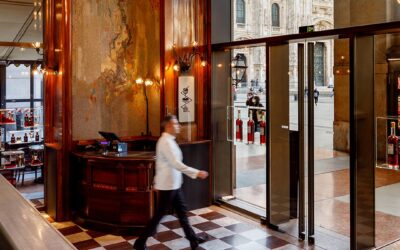

Since 1867, Caffè Camparino in the Galleria Vittorio Emanuele in Milan has recorded a total of 87 instances of broken windows caused by political demonstrators who were rampaging under the arcades of Piazza del Duomo and in the Galleria.
Caffè Florian in Venice, Caffè Greco in Rome, and Caffè Cova in Milan: armed with international patents, they are increasingly trying to protect themselves.

In un muro dell’Hotel Cocumella, di S. Agnello di Sorrento, la leggenda racconta che l’ultima amante di Shelley, Claire Jane Clairmont, nascose una teca che conteneva il cuore del poeta, avuto in dono da Byron, che lo strappò dal corpo dell’amico affogato a Lerici.

The Bar del Tasso in Bergamo served as a recruitment point for the many young people who joined Garibaldi for the Expedition of the Thousand; the Antica Focacceria S. Francesco in Palermo was the first “food stop” for Garibaldi and the Thousand after they landed in Marsala.

The Antica Locanda Mincio, in Valeggio sul Mincio, in the province of Verona, where Napoleon stayed in 1796 after driving the Austrians across the river.
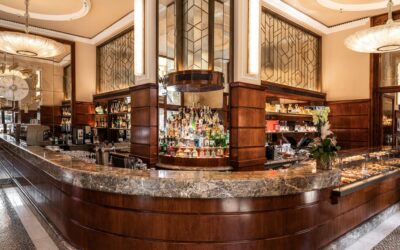
It is the Caffè Paszkowski in Florence (pronounced “Pascovschi”), nicknamed “pazzoschi” by the Florentines because of the somewhat eccentric characters who frequented it in the early 20th century.

The Grand Hotel Villa d’Este in Cernobbio, in the province of Como, where photojournalist Fedele Toscani (Oliviero’s father), in 1933, through shrewd and patient stakeouts, managed to photograph the idyll between Bessie Wallis Warfield—better known as Wallis Simpson—and Edward VIII, who would soon abdicate the throne of England in order to marry her.
The Bellevue Syrene, Excelsior Vittoria, Imperial Tramontano, and Royal hotels in Sorrento, with breathtaking views of the Gulf of Naples.

Sandri di Perugia is the last historic pastry shop still run by the descendants of the more than 100 Swiss pastry chefs who, in the 1800s, came to Italy in search of fortune and opened workshops and shops that have become “legends” in the art of pastry-making.
A journey through fascinating facts for film history enthusiasts, presented in the order in which they were discovered. Some of the earliest outdoor film shots were shot at the Excelsior Palace Hotel in Rapallo for the film “Battesimo di nave” (1914), starring and directed by Gian Paolo Rosmino, a historic figure in Italian cinema. At the Caffè Ristorante La Loggia in Florence, in the summer of 1916, Arnoldo Ginna set the scene of the elderly gentleman being accosted by young Futurists (to symbolize the contrast between the traditionalist world and the dynamism of the new culture) in the now-untraceable film “Vita futurista,” conceived, among others, by the father of Futurism, Marinetti, and the painter Balla…

In the 1930s, the Ambrosiana-Internazionale team—featuring Castellazzi, Alemandi, De Manzano, Meazza, Faccio, Levratto, Bitto, Agosteo, Cerasoli, Frione, and Serantoni—was a regular at the Antico Ristorante Boeucc in Milan.
Caffè Gilli in Florence, where Prezzolini used to meet with the editors of the literary magazine “La Voce” between 1908 and 1916; Caffè Mangini in Genoa, which, after World War II, served as a makeshift newsroom for the daily newspapers *Il Secolo XIX* and *Il Lavoro*, with legendary editors such as Cavassa and Pertini.