Last News

The most Swiss pastry shops

The most Swiss pastry shops

Sandri di Perugia is the last historic pastry shop still run by the descendants of the more than 100 Swiss pastry chefs who, in the 1800s, came to Italy in search of fortune and opened workshops and shops that have become “legends” in the art of pastry-making.

read more

The most cinematographic

A journey through fascinating facts for film history enthusiasts, presented in the order in which they were discovered. Some of the earliest outdoor film shots were shot at the Excelsior Palace Hotel in Rapallo for the film “Battesimo di nave” (1914), starring and directed by Gian Paolo Rosmino, a historic figure in Italian cinema. At the Caffè Ristorante La Loggia in Florence, in the summer of 1916, Arnoldo Ginna set the scene of the elderly gentleman being accosted by young Futurists (to symbolize the contrast between the traditionalist world and the dynamism of the new culture) in the now-untraceable film “Vita futurista,” conceived, among others, by the father of Futurism, Marinetti, and the painter Balla…

read more
The closest to soccer

The closest to soccer

In the 1930s, the Ambrosiana-Internazionale team—featuring Castellazzi, Alemandi, De Manzano, Meazza, Faccio, Levratto, Bitto, Agosteo, Cerasoli, Frione, and Serantoni—was a regular at the Antico Ristorante Boeucc in Milan.

read more

The most journalistic

Caffè Gilli in Florence, where Prezzolini used to meet with the editors of the literary magazine “La Voce” between 1908 and 1916; Caffè Mangini in Genoa, which, after World War II, served as a makeshift newsroom for the daily newspapers *Il Secolo XIX* and *Il Lavoro*, with legendary editors such as Cavassa and Pertini.

read more
The most pugnacious

The most pugnacious

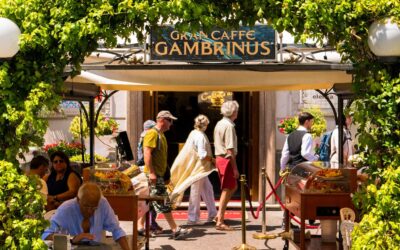
The Gran Caffè Gambrinus in Naples: the family that runs it fought for nearly 30 years to regain the portion of the café that, in 1938, was converted into a bank after a high-ranking Fascist official asked the prefect to close it because the noise coming from the café—which was located beneath his home—disturbed his wife’s bridge game. With a touch of satire, Alberto Savinio, De Chirico’s brother, wrote in the weekly magazine *Omnibus* that “the air of Naples is fatal to fine cafés, just as roses are poisonous to donkeys,” and the regime ordered the publication to be shut down as well. In 2001, the two parts of the Gambrinus were reunited, thus bringing together those splendid rooms that serve as an art gallery housing over 40 paintings by the greatest names in 19th-century Neapolitan painting.

read more
The most flooded

The most flooded

Caffè Lavena in Venice, located beneath the Old Procuratie in St. Mark’s Square, is literally flooded every time high water hits.

read more
The top top-guests

The top top-guests

They are undoubtedly Goethe, who stayed at countless historic establishments during his “Italian Journey”; D’Annunzio, who—whether with or without Eleonora Duse—left broken hearts and unpaid bills everywhere he went; and Ernest Hemingway, a regular at countless historic bars, including the one at the legendary Hotel de La Poste in Cortina d’Ampezzo.

read more
The first goliard

The first goliard

In 1820, at the Caffè dell’Ussero in Pisa, the oldest documented episode of Italian student pranks took place, as described by Ersilio Michel in *Maestri e scolari dell’Università di Pisa nel Risorgimento nazionale* (Sansoni, 1949). A certain Ricci, a student from Livorno, climbed onto a small table and read aloud a witty satire in sestinas that mocked the more well-mannered and moderate students: he imagined them forming their own monarchical government, with the King granting them court positions and establishing the Knightly Order of the Donkeys. The next day, Ricci was given two hours to leave Pisa, having been suspended from the university.

read more
The most “Dionysian ear”

The most “Dionysian ear”

In the splendid Sala Cardinali of the Grand Hotel Cocumella in Sant’Agnello, Sorrento—whose walls are adorned with portraits of the four high-ranking prelates that Sorrento has given to the Church—in the left-hand corner opposite the entrance, you can clearly hear what a person is whispering in the right-hand corner of the entrance.

read more
The Most Art Nouveau

The Most Art Nouveau

Undulating, dynamic, inspired by nature, beautiful: whether from their original construction or following renovations in the late 19th century, over seventy historic venues in Italy embraced the Art Nouveau style. Here they are, brought together in an ideal itinerary to be explored for the pleasure of a “floral stop.” The research was conducted for the 2013 edition and has become part of the historical and cultural heritage of the Guide and the Association of Historic Venues of Italy.

read more
The Most “Unità d’Italia”

The Most “Unità d’Italia”

These are the establishments which, during the Risorgimento, witnessed episodes that led to the Unification of Italy. Brought to light by research for the 2011 edition of this Guide, which paid tribute to the 150th Anniversary of the Unification of Italy these stories have become part of the Association’s historical legacy.

At the Caffè Fiorio in Turin—a gathering place for staunch conservatives—on March 18, 1821, they attempted to persuade the court apothecary’s assistant to poison the medicine of Carlo Alberto of Savoy, who had just been appointed Regent and had promulgated the Constitution…

read more