
Andria (Barletta-Andria-Trani). Two of the great names in Andria were loyal friends of the family at the Confetteria Mucci Giovanni, coming personally to buy their confectionery and, especially, the traditional carnival delights: Count Onofrio Iannuzzi, senator from the first to fifth legislature of the Republic under Prime Minister De Gasperi, one of the fathers of the Italian Republic, and Cardinal Corrado Ursi, Archbishop of Naples.
Arezzo. In 2008, Senator Giulio Andreotti, seven-times prime minister of the Italian Republic, spent time in the “Life is Beautiful” room of the Caffè dei Costanti, which he had heard about from a former companion- in-arms, and was curious to see how the café had been restored. He talked with the managers about the problem of alcohol abuse among both young and old.
Asolo (Treviso). The English poet Robert Browning discovered Asolo at the age of twenty-six, during his first trip to Italy: it was here that he set his first poem “Sordello”, and the town inspired his verse drama Pippa Passes. His last collection of poems, “Asolando”, was dedicated to the city. From 1878 onwards, he stayed here almost every time he came to Italy, and he could also be seen at the Caffè Centrale, sitting – it is said – where the central sofa is today.
Bassano del Grappa (Vicenza). Sitting comfortably at the romantic little corner table by the window overlooking the Brenta, the Queen Mother of England enjoyed a little grappino at the Grapperia Nardini on 27 May 1987. On a visit to Bassano, she was passing by the famous Grapperia when she ordered her escort to stop and, to everyone’s surprise, dashed in, drank her beloved grappa and left her regal signature “Elizabeth R.” and the date in the book of distinguished guests. She loved Nardini, which she had known for ages and which she had wanted as the only Italian spirit for the wedding of her daughter Elizabeth II.
Bologna. When she was invited to “Pavarotti and Friends” on 12 and 13 September 1995, Lady Diana Spencer, Princess of Wales, booked into the fabulous Giambologna- Guercino presidential suite at the Grand Hotel Majestic già Baglioni in Bologna. Giosuè Carducci used to stop by at Paolo Atti & Figli’s to buy his tortellini: from 1860, and throughout the 43 years he spent teaching Italian Literature at the university, he was famous for his eloquence and also for his formidable appetite.


Burano (Venice). Right in the middle of the great hall of the Ristorante da Romano there is a 4-6-seat table known as that of “the painters” because it was here, in the immediate post-war years, that such artists as Pio Meneghini, Filippo de Pisis and Emilio Vedova would sit after their painting excursions on the island. Romano Barbaro, the owner, fitted the table with some little drawers in which the painters could put their albums and pencils. Also Chaplin and Callas wanted to be at this table. The hall is unmistakable, for paintings are “crammed on the walls like stamps” (as Orio Vergani, founder of the Accademia Italiana della Cucina, put it).
Caprile-Alleghe (Belluno). From the summer of 1884, the poet Giosuè Carducci began to spend his holidays in the mountains, for health reasons. In 1886 he was in Caprile at the Albergo alla Posta, in what was then room number 3 with a view of Monte Civetta (ask the fifth generation of the Pra family which room that is today!), where he finally finished his famous poem “Davanti a San Guido” in a particularly creative moment. “Carducci adored the food, with venison and wild trout, served by my grandparents”, recalls the owner, Floriano Pra, and Carducci wrote “I fall asleep reading Shakespeare. I eat excellent meat, and trout that taste like nymphs: I play briscola and would write poems.”
Cernobbio (Como). Alfred Hitchcock first stayed in Room 133 at the Grand Hotel Villa d’Este in 1925, when he had inspiration for his first experience as a film director with The Pleasure Garden, and indeed he set some scenes in the hotel grounds and in Cernobbio. He was so fond of Villa d’Este that he spent his September holidays there until 1970. Always in his beloved “133”.
Cogne (Aosta). On holiday in early September 1931, King Albert I of Belgium, his daughter Maria Josè of Savoy and Umberto of Savoy stayed in rooms 210 and 310 of the Hotel Bellevue & Spa: a lovely photograph shows them on their respective balconies and their signatures are in the book of illustrious guests. The royal family of Italy – along with the cream of European nobility – often went to Cogne, partly because the Gran Paradiso was a royal hunting reserve.
Cortina d’Ampezzo (Belluno). “We saw him arriving with suitcases and with his wife Mary one January day in 1951. We knew Hemingway well, because since 1948 he had been a regular at our bar, downing Martinis and red wine, when he rented the little Villa Aprile. He knew Cortina well and loved it, because here he could work in peace, eat well at Rachele’s, and have Renato, our bartender, listen to him for hours. We gave him Room 107 which has remained as it was ever since, and is now named after him.” This is how Marisa Manaigo, heart and soul of the legendary Hotel de La Poste, recalls the great American writer’s stay at her hotel. The actor Renato Salvatori, a friend of the Menardi family and the unforgettable star of such films as Mario Monicelli’s The Big Deal and Luchino Visconti’s Rocco and His Brothers, spent his summer and winter holidays at the Albergo Menardi from 1978 to 1987, in Room 223.
Cremona. Giuseppe Verdi regularly appeared at the counter in the Negozio Sperlari, where he would order Italian and foreign wines, and sweets which he had sent to his villa in Sant’Agata, near Piacenza. His permanent residence from 1848, together with his partner and later wife, Giuseppina Strepponi, this was where he composed his major operas.
Cuneo. Hemingway in person appeared at the counter of the Caffè Pasticceria Arione on 8 May 1954 and bought two kilos of the famous Cuneesi al Rhum for his wife, who was on holiday in Nice. It was his publisher, Arnoldo Mondadori, who suggested the tempting stop on the way to France. And, true to himself, the writer ordered an aperitif while he was about it.


Florence. November 1966. While filming Florence: Days of Destruction, the splendid RAI documentary on the city during the dramatic days of the flood, the director Franco Zeffirelli and Richard Burton, accompanied by Elizabeth Taylor, would go every evening to the table “di terrazza” (number 15), which overlooked the inner garden of the Ristorante Sabatini. Zeffirelli wanted Burton’s dramatic power as a narrator in both English and Italian to explain to the world the true impact on his city of the tragic flood. One historic photograph, taken in 1951, shows Papini, Soffici, Spadolini and Bargellini (the legendary mayor of Florence during the 1966 flood) gathered around a table under the arches of the Caffè Ristorante La Loggia in Piazzale Michelangelo.
Gardone Riviera (Brescia). Winston Churchill booked into room number 310 at the Grand Hotel Gardone for the fortnight in late July, early August 1949. Room 316 was reserved for possible guests and, for security reasons, the entire third floor was set aside for the statesman: 11 rooms overlooking the lake and 4 on the national road! Churchill, who came with a double escort and 44 suitcases, instantly disappeared into his room, went back down in slippers- dressing-gown-and-cigar and went for a backstroke swim in the lake, sending reporters on a wild chase after him.
Genoa. The composer Giuseppe Verdi, who from 1874 to 1900 spent his winters with his wife Giuseppina Strepponi in Genoa, in an apartment in Villa del Principe, loved to do his shopping himself and he often went to the Confetteria Romanengo in Via Macelli Soziglia to choose his favourite delicacies. Words of his passion for Romanengo can still be seen in a letter he wrote in 1881 to his friend Count Opprandino Arrivabene. Frank Sinatra, with his wife Barbara, Roger Moore and two bodyguards, dined at tables 3 and 4 of the Ristorante Zeffirino: he flew in from Monte Carlo on his private plane but also had his limousine brought for the trip to and from the airport.


Lucca – Sesto di Moriano. One of the regulars at the Antica Locanda di Sesto in the 1990s was Paola Borboni, one of the greatest actresses in Italian theatre, with an extraordinary career from 1916 to 1994. She had shocked Italy in 1925 with the first bared breast on stage in Alga marina at the Manzoni in Milan, and again in 1941 in the film The Jester’s Supper by Alessandro Blasetti. Her favourite table was number 7 in the main hall.
Milan. From the 1980s, after each concert he conducted at La Scala, Maestro Claudio Abbado used to eat at one of the corner tables in the hall of columns at the Ristorante Boeucc. For official meetings he would choose the private room with the large oval table. Like other artists, Marcello Nizzoli, Fortunato Depero and Marcello Dudovich, the fathers of modern advertising posters and the creators of the most famous advertisements in the early twentieth century, would enjoy an aperitif at the counter of the Caffè Camparino in Galleria. Antonio Greppi, the first post-Liberation mayor of Milan, one of the founders of the Committee of National Liberation in Northern Italy and a member of the Resistance, would spend time at one of the outdoor tables of the Bar Gin Rosa in the Galleria San Babila. Frank Sinatra occupied the fabulous suite at the Hotel Principe di Savoia when, on 27 September 1986, he put on his super- concert for the opening of the PalaTrussardi. The event sold out, and the first 23 rows were all taken by international celebrities. It was quite a show, because he had not sung in Italy for almost 25 years and it revived the tours in Italy by great international stars, that had been brought to an end by terrorism in 1981. Sinatra returned to Milan, and to his suite, in 1989 and again in 1991 during his last tour in Italy. In 1996, after the show at the Teatro Nuovo, the extraordinary star of the play Ultime lune, the then very sick Marcello Mastroianni, would sit each night at the corner table in the second room of the Ristorante a Santa Lucia.
Montepulciano (Siena). In the enchanting great hall of the Caffè Poliziano, the film director Federico Fellini always loved to sit in lounge number 2. In August 1992, with his wife Giulietta Masina, he was a special guest at the Caffè, where he opened the I disegnatori de Il Grifo exhibition, a review of works by the greatest comic-book artists, with splendid originals by Milo Manara, Danijel Zezelj, Andrea Pazienza and Fellini himself.
Naples. Ask at the Ristorante La Bersagliera for the favourite table of Totò, one the greatest actors in Italian theatre and cinema, and they will show you where he had himself filmed while enjoying a plate of spaghetti and sea bass with a good glass of wine: the film was screened in 1953 and 1954, in Settimana Incom, the weekly cinema newsreel that was shown before the feature film in all cinemas until 1965. Totò never wanted to advertise for anyone, but he made this gift to the proprietor, Donna Emilia Del Tufo – known by all as “la Bersagliera” – and to her son Agostino, with whom, when he was on his own, he would always enjoy a chat. From the postwar period to the sixties, the actor Eduardo De Filippo, the heart and soul of Neapolitan theatre, loved to eat at the Ristorante Umberto: his table was number 19 in the little room with curtains. And often, when he was performing at a nearby theatre and ordered a take-away meal, it would be brought to him by the Di Porzio family in person.
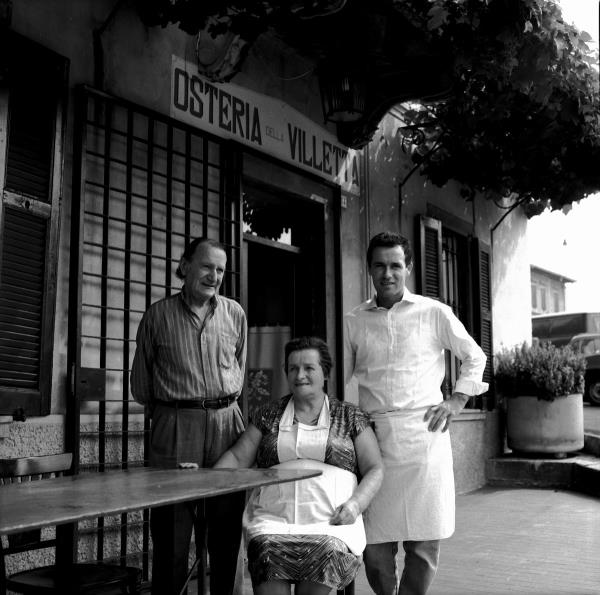
Palazzolo sull’Oglio (Brescia). In March 2000, the Osteria della Villetta hosted two founders of the Nouveau Réalisme movement on its Liberty-style veranda: celebrated by Italian culture, the French art critic Pierre Restany and the painter Mimmo Rotella, the only Italian artist among the founders, took a table while the memorable meeting was on at the Teatro Sociale di Palazzolo. Organised by the Fondazione Ambrosetti Arte Contemporanea, it was dedicated to these two exponents of the cultural debate in the fifties and sixties. Testimony of their visit can be seen on the walls of the room.
Pavia. The famous astrophysicist Margherita Hack’s favourite suite at the Hotel Moderno was number 216 when, between 2004 and 2009, she used to lecture in Pavia at the prestigious Ghislieri university college and at the University.



Perugia. In the 1960s, King Gustav of Sweden walked into the Pasticceria Sandri in Perugia, took his coffee and croissant, sat down at one of the indoor tables and, when he had finished, personally took his cup and plate back to the counter and said, “That’s the way to do it!”
Pesaro. In the late 1920s, the writer and playwright Luigi Pirandello booked into Room 306 at the Hotel Vittoria. He liked taking a break on the famous terrace overlooking the sea, where he used to order a cocktail invented by the barman, Alfredo, who called it the “mule-kick” for its knock-out effect.
Pisa. The poet Gabriele D’Annunzio often came to the Royal Victoria Hotel, where he would always take Room 17, now 202. Although 17 is considered unlucky in Italy, his legendary superstitions were very English: his unlucky number was 13, which he wrote as “12 + 1” and, for him, the year 1913 was always “1912 + 1”.
Ponte a Moriano (Lucca). In the late nineteenth and early twentieth century, the poet Giovanni Pascoli would often stop for a meal under the pergola at the Ristorante Erasmo (then Trattoria “La Presa dell’Acqua”), because it was on his way back from Lucca to his home in Castelvecchio di Barga. Ask the fifthgeneration Lorenzo and Paola Marcucci and they will show you to the ancient room where Marcello Mastroianni used to go, and where the writer and director Mario Soldati ate with De Sica and Lollobrigida.
Recco (Genoa). The slate table now at the entrance of the Ristorante Manuelina is the one at which Ernest Hemingway, then a correspondent in Europe for the Toronto Star, enjoyed salami and cheese focaccia together with Ezra Pound and his partner, the violinist Olga Rudge, and the young Rapallese doctor Giuseppe Bacigalupo. Aboard a Fiat Torpedo, they had found him with his broken-down car near Recco, rescued him, and brought him here to eat with them. While waiting for the mechanic at the Manuelina, Hemingway carved his name, still faintly visible today, on the table. In the spring of 1950, Luigi Einaudi, then president of the Italian Republic, had lunch at the corner table in the ballroom of the Ristorante Ö Vittorio while attending the historic opening of the new town hall, which had been rebuilt after the total destruction of Recco during the terrible bombing raids in 1943-44.


Rome. Chiara Bedini and Rory Bruce, the fourth generation at the helm of Babington’s Tea Rooms, recall how “during the 1930s, with the rise of Fascism, the city’s suspiciously ‘un- Italian’ tea rooms began to disappear. It is inexplicable how Babington’s with its name – English Tea Rooms – in bold bronze characters beside the door, should become fashionable among high-ranking members of the regime, politely served with tea and scones in the first room while around the corner the anti-fascist intelligentsia met to confabulate (with their emergency exit through the kitchens)”. The legendary Buffalo Bill was photographed at the penultimate table on the right in the Omnibus room at the Caffè Greco in 1906. But, of the countless celebrities who have been to the Greco, one of the most famous cafés in the world, they can also tell you where the rather shy painter Giorgio de Chirico used to sit. He lived very close by and loved the place. He would always drop in for an aperitif at noon on the dot, with some pencils in his pocket so that he could make quick sketches for customers and waiters and thus have some cash to spend. His second wife, Isabella Far, was worried about his awful distractedness and let him out only with enough money for a single drink at Greco’s!
San Candido (Bolzano). In August 1989, Giovanni Spadolini booked into the Schloss Tirol Suite at the Hotel Cavallino Bianco. A politician, journalist and essayist, he was one of the greatest scholars of the history of nineteenth- and twentiethcentury Italy, and for this reason was elected president of the Italian Institute for Historical Studies, founded by Benedetto Croce.
San Polo di Piave (Treviso). Ernest Hemingway discovered the Locanda Gambrinus in June 1918, during the First World War, when he was stationed at Villa Ca’ Erizzo sul Brenta as a volunteer Red Cross driver. He liked to go onto the terrace at the source of the river Lia, where he would dip homemade bread into Raboso Piave wine and where he also adored the Gambrinus’s Elisir liqueur.
S. Agnello di Sorrento (Naples). On 3 September 1902, Sigmund Freud wrote a letter to his family from Room 114 at the Grand Hotel Cocumella, where he was spending a week with his brother Alexander. In it he describes the beautiful park of the hotel, with its pine trees and orange and lemon trees, and the stunning landscape of the Gulf of Naples, which he could admire from the terrace: “It is a magnificent panorama. I just cannot tear myself away to go and see other landscapes.”
Santa Margherita (Genoa). In 1933, when Guglielmo Marconi transmitted the world’s first radio-telegraph and radiotelephone signals over a distance of 150 kilometres, in the form of 60-cm microwaves from the terrace of the Grand Hotel Miramare, he was staying in Suite 105, which now bears the name. The scientist made the Miramare his official reception venue, where he received friends and personalities.
Sirmione (Brescia). While on tour between 1955 and 1958, the soprano Maria Callas sometimes took refuge in her husband Giovanni Battista Meneghini’s beautiful villa in the old part of town, and she would often be seen enjoying a Campari soda at the Caffè Grande Italia, where she made great friends with the proprietors, the Pagiaro family. Her table was in the left-hand corner of the tea room, where she often worked on scores in the company of the tenors Corelli and Di Stefano.
Sorrento (Naples). The famous singer Lucio Dalla was a guest at the Grand Hotel Excelsior Vittoria in 1986: overlooking the sea on the large terrace of his suite on the fifth floor of the Palazzo Rivale, he was inspired by a famous former guest, and wrote “Caruso”, a song that went around the world also with the voice of the tenor Pavarotti. The Fiorentino family dedicated the “Appartamento Lucio Dalla” – the Dalla Suite and the Junior Suite 547 – to their late friend. The piano he played, his original records and, above all, his music are all still there.
Stresa (Verbania). The “Hemingway Suite” (rooms 104, 105 and 106) at the Grand Hotel des Iles Borromées are where the American writer stayed in 1948, signing the guest book as “an old customer”. He adored this hotel because, at a very young age he had spent his convalescence here for a war wound in 1918 – when he was a Red Cross volunteer – and it was on its terrace that he started working on parts of A Farewell to Arms, bringing eternal fame to the hotel and to the lake he so loved.


Turin. The table under the clock at the Caffè al Bicerin was the favourite of Camillo Benso, Count of Cavour, minister of the Kingdom of Sardinia and later first prime minister of the Kingdom of Italy: on the Sundays when he accompanied the king and queen to Mass at the Basilica of the Consolata, he chose this spot because it was the best place from which to see when the royal couple were about to leave the church, so he could then accompany them back to the Castello.
At the Ristorante del Cambio, a tricolour ribbon indicates the table where the Count of Cavour used to sit during breaks in political meetings, because this was the best place for observing who entered and left the Subalpine Parliament in the building opposite. An allegory, just above the table, shows Cavour with his trusty secretary Costantino Nigra. In the 1990s, the writer Mario Soldati had his table at the Ristorante Porto di Savona, in the corner of the tiny room by the entrance, where he could savour a cigar without incurring the ire of too many guests.
Tremezzina (Como). The splendid Greta Garbo Suite at the Grand Hotel Tremezzo is dedicated to the famously reserved “Divine” actress, who stayed here in the 1930s. Garbo loved the hotel and Tremezzo, which she quoted in the film Grand Hotel in 1932.
Venice. Room 243 at the Hotel Ala is dedicated to Countess Maria Tarnowska, the wily adventuress who, in the early twentieth century, had her betrothed husband Count Pavel Kamarowsky murdered so that she could get her hands on his massive fortune. The young countess was discovered and put on trial, and the ensuing “Russian affair” blew the lid off the outrageous, dissolute lifestyle of the Russian aristocratic community in Venice, attracting the morbid curiosity of all Europe. The room is right in the area of the ancient Palazzo Maurogonato – now part of the hotel – where the count was staying when he was mortally wounded by the countess’s young lover, whom she had subjugated and instigated to shoot his older rival. In 1877, John Ruskin, author of The Stones of Venice, stayed in Room 2 of the Hotel La Calcina, which was then a boarding house. In the “Senate Hall” of the Caffè Florian in 1890, a group of intellectuals came up with the idea of creating the Biennale, the prestigious international art exhibition in Venice, which first opened in 1895: they were the poet and mayor of Venice Riccardo Selvatico and his friends Antonio Fradeletto, senator of the Kingdom of Italy and essayist, and the painters and architects Mario de Maria and Augusto Sezanne. A wooden sculpture by Vincenzo Cadorin recalls how from 1879 to 1883 the composer Richard Wagner would often go to the Caffè Lavena, where he would think and write: he used to sit in the right-hand corner of the loggia on the first floor, looking out of the little window at the basilica, the Doge’s Palace and the people in St Mark’s Square for inspiration. Here he completed the love duet in the second act of Tristan and Isolde and also worked on his Parsifal. At five in the afternoon, his wife Cosima and their children would come for tea, cognac and biscuits, which the proprietor Carlo Lavena baked in the three ovens of the Caffè Lavenino, in the Calle Frezzaria. The Argentine writer and poet Jorge Luis Borges had a passion for Venice and, between 1962 and 1965, he used to book into the Hotel Londra Palace, in the suite that now bears his name. Long before his time, in 1877, as a plaque recalls, Tchaikovsky completed the first three movements of his Symphony no. 4, while staying in Room 106 of the hotel, which in those days was called the Beau Rivage. In 1881 the writer Henry James was a guest in Room 47 of the boarding house that is now the Hotel Ristorante Wildner. “I lodged on the Riva, quarto piano. The view from my window was una bellezza; the far-shining lagoon, the pink walls of San Giorgio, the distant islands, the movement of the quay, the gondolas. Here I wrote, diligently every day and finished, or virtually finished, my novel”, wrote James, referring to the distractions that made it so hard for him to finish his novel Portrait of a Lady in that room.


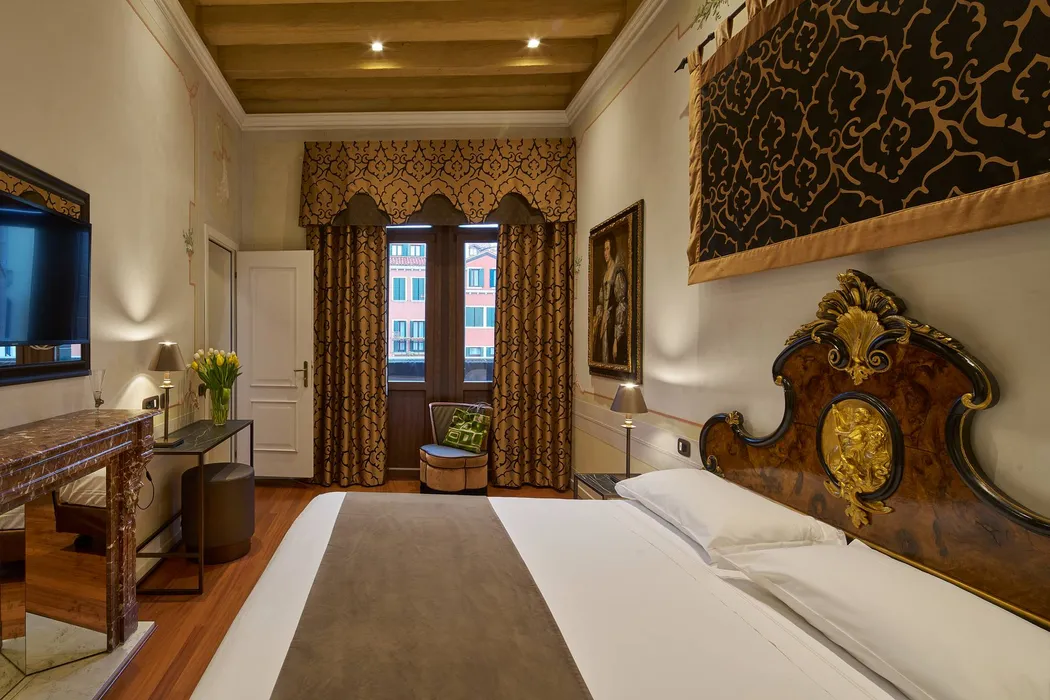


Venice Lido. In 1985, while filming part of Mario Monicelli’s film The Two Lives of Mattia Pascal, from the novel by Pirandello, Marcello Mastroianni spent almost a month in the fairy-tale tranquillity of the Albergo Quattro Fontane: he stayed in the “ai Nani” room of the La Barchessa outbuilding, where each room is named after a Venetian villa.
Verona. When Ernest Hemingway was in Venice in 1948- 49, writing Across the River and into the Trees, he often went to the Ristorante Casa Perbellini – 12 Apostoli in Verona, when he went to meet his publisher Arnoldo Mondadori and the publisher-printer Giovanni (Hans) Mardersteig. He liked to sit in the corner of the little room, where his signature is now reproduced. The pianist Arturo Benedetti Michelangeli spent many months in the hills of Verona between 1975 and ’85, practicing alone in the house of the Toledano family. These were friends of the Gioco family, the owners of 12 Apostoli restaurant, where Michelangeli would often be seen sitting at the table by the left of the entrance.
Lugano (Switzerland). On 3 March 1945, the beautiful dining room of the Grand Café Al Porto – where one can also book for a memorable tête-à-tête – was the meeting place for the five men who saved Italy from the infamous “Operation Scorched Earth”, the apocalypse ordered by Hitler, in which the Germans were to raze Italy to the ground before abandoning it if they lost the Second World War. In those days it was called “Ristorante Bianchi” and the operation was code-named “Sunrise”. In this room, the wealthy businessman and patriot, Baron Luigi Parrilli, Professor Max Husmann, the principal of a college in Zurich but actually a Swiss secret services consultant, and Major Max Waibel, a commander in Lucerne at the counterintelligence news collection service from Germany and Italy, convinced Lieutenant Guido Zimmer, head of German counterintelligence in Milan, and especially SS Colonel Eugen Dollmann, who represented General Wolff, head of the SS in Italy and Marshal Kesselring, the supreme commander in Italy, not to obey Hitler’s terrible order should it ever come. And that is the way it was. The most regal suite at the Hotel Splendide Royal is number 107: it was here that, in 2005, slept none other than His Royal Highness Prince Philip, Duke of Edinburgh, guest of honour at the Panda Ball, which was held in the hotel, the great gala evening organised every year by the WWF to raise funds for the environment, during which he awarded the prestigious Duke of Edinburgh Conservation Medal.
New York (United States). Al Pacino’s favourite table at the Caffè Reggio is the first on the left outside the front door, where he was also shown reading a script in a photo of 1989.